
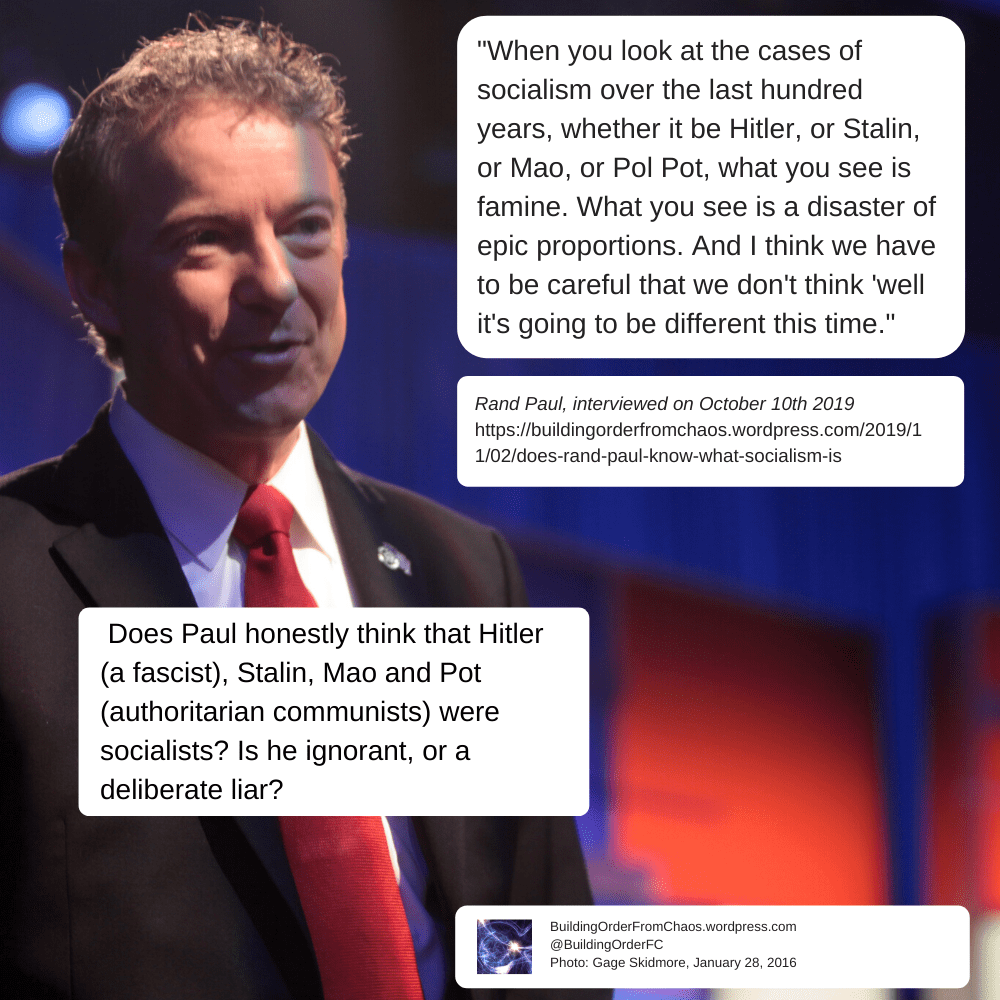
Many members of the modern Republican party are willing to say things that are blatantly untrue. In fact it often seems a requirement rather than a flaw. This tendency does not just apply to matters surrounding Donald Trump, but the discussion of basic political terminology, as Rand Paul proved when being interviewed on The Daily Show a on October 10th.
Paul, who was appearing to promote his new book The Case Against Socialism offered his definition of why socialism is a bad idea, saying
“When you look at the cases of socialism over the last hundred years, whether it be Hitler, or Stalin, or Mao, or Pol Pot, what you see is famine. What you see is a disaster of epic proportions. And I think we have to be careful that we don’t think ‘well it’s going to be different this time.”
This definition of socialism is laughably stupid, and made me long for the peak of The Daily Show under Jon Stewart. The Daily Show has always been a light entertainment show, but from my memory Stewart was a sharper interviewer than Trevor Noah, more willing to cut into his guests’ bullshit rather than trying to meet anyone halfway, as Noah seems to prefer.
I’ve previously written about the reasons why we know that the National Socialists weren’t socialists. Among the reasons is the fact that Hitler took large donations from super-rich industrialists like Fritz Thyssen, and later privatised state assets into their hands. The then common term for the selling-off of state assets to the private sector – denationalisation – obviously couldn’t be used by a party calling themselves the National Socialists. So they had to invent the now common term privatisation to describe the process. In a 1933 speech Hitler announced that “the government will not protect the economic interests of the German people by the circuitous method of an economic bureaucracy to be organised by the state, but by the utmost furtherance of private initiative and by the recognition of the rights of property.”
If you’re going to believe that Nazi Germany were socialists just because they described themselves that way, you might as well believe that North Korea – aka the Democratic People’s Republic of Korea – is democratic. You might as well believe that modern China – home to roughly 55 billionaires – is communist.
The ideologies of Stalin, Mao and Pol Pot are probably best defined as authoritarian communism and are of course gruesome. But authoritarian communism is not socialism. Socialism – which is becoming more popular in America and the UK in recent years – is merely an attempt to sand off the rougher edges of capitalism. It’s a belief, for example, that something should be done about the half a million US bankruptcies a year caused by healthcare bills. That’s a long way from the extreme attempts to reinvent a country from ‘Year Zero’ that Stalin, Mao and Pot undertook.
Rand Paul: “One of the great principles of our country is we have always resisted centralisation of power. We didn’t like a king, and we didn’t like a powerful president and we still resist the idea – and we promote the idea of separation of power and checks and balances.”
Trevor Noah: “But could one not argue that capitalism has gotten to a point in America where you do in fact have kings and rulers. You do in fact have people who define how other human beings can live.”
Of course any ideology can go too far, and we should all be self-reflective and critical of the movements we ally ourselves too. But the same applies to Paul. During the interview Paul made a differentiation between “honest capitalism” and “crony capitalism”, arguing that the latter rely on government subsidies and patents to distort the free market, but that in the ‘honest capitalism’ the rich get rich by giving people what they want. His example of ‘honest capitalism’ was Sam Walton – of the famously anti-union WalMart.
If we should resist the idea of national leaders becoming too powerful – and this is an point where I agree with Paul – then it stands to reason that we should also resist the idea of capitalist leaders becoming too powerful. 1.4 million Americans – one in every hundred members of the workforce – are employed by WalMart. By definition this causes a centralisation of power, and under a set of rulers who are not democratically accountable. WalMart uses this power to – in Noah’s words – “define how other human beings can live” by attacking their workers’ legal right to unionise. WalMart has specialist hotlines for managers to report workers they suspect of unionising, and have what they call ‘Delta Teams’ to stalk workers putting into practice their legal right to unionise.
In addition to this authoritarian use of the power it has over its workers, WalMart seems more like Paul’s definition of ‘crony capitalism’ than the ‘honest capitalism’ that he categorised them under. A 2014 study concluded that WalMart employees receive $6.2 billion a year in “public assistance including food stamps, Medicaid and subsidized housing” – effectively a state subsidy for WalMart’s low wages. I think it’s fair to ask whether WalMart’s business model would work without the existence of the state, and America’s fairly limited form of socialism.
In the same interview Paul praised the principle of “checks and balances” – implying that these don’t happen under socialism – while arguing against impeachment – arguing instead that it would be wrong to use the law to hold Trump to account, and Americans should wait until the next election. But what is the point of having checks and balances if they’re not going to be used? If Paul’s logic is consistent, he should believe that Richard Nixon should not have been impeached for his part in a burglary – a pretty straightforward example of a crime which ordinary citizens would expect to be punished for committing.
Paul’s cynicism in misrepresenting political philosophies is unfortunately, not a rare phenomenon. It’s important that ordinary voters teach ourselves to see through these manipulations.
 Happy Sisyphus
Leave a comment