
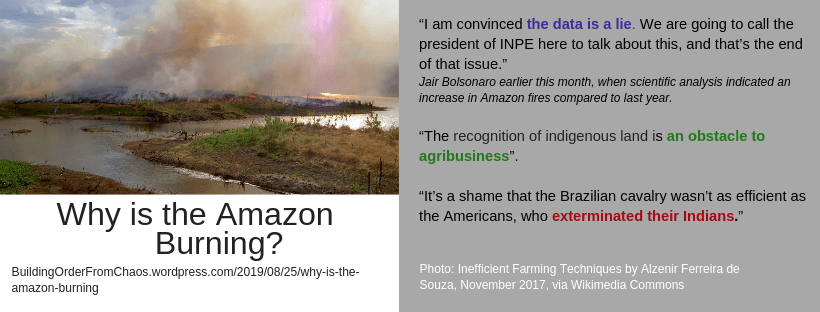
Earlier this month Brazilian president Jair Bolsonaro referred to scientific data showing an increase in fires in the Amazon as “lies”. He fired Ricardo Galvão, the director of Brazil’s National Institute for Space Research (INPE), the body who gathered this inconvenient data, drawing condemnation from the Union of Concerned Scientists.
“I am convinced the data is a lie,” he said. “We are going to call the president of INPE here to talk about this, and that’s the end of that issue.”
The INPE has counted 74,155 wildfires in 2019 up until August 20th, an 84% increase on the same period in 2018. Land-grabbers with chainsaws, known as grileiros, are a major threat to the Amazon. Last year Apurinã Indians found 1000 hectares of their ancestral forest-land burned with kerosene. According to Vitor Gomes, an environmental scientist at the Federal University of Para, “attributing the whole episode to natural causes only is practically impossible.” The INPE are not alone in reaching their conclusions – according to Imazon, a Brazilian research centre, in the early months of 2019, deforestation jumped more than 50% against the previous year.
Bolsonaro has suggested that in future data gathered by the INPE – currently uploaded online daily – could be vetted by his government before being made public.
When asked about the global warming more generally, Bolsonaro has said that “It’s enough to eat a little less. You talk about environmental pollution. It’s enough to poop every other day.”
It’s possible that he isn’t taking the threat of climate breakdown seriously.
Bolsonaro’s chief of staff Onyx Lorenzoni, when asked about global warming during last year’s election campaign, told journalists that “There are things that are solid and there are things that are ideological,” adding that “Brazilians will be in charge in the Amazon, my brother, not the Europeans.”
During the campaign Bolsonaro praised Donald Trump’s decision to withdraw America from the Paris climate agreement, hinting that he would do the same if elected. (Under the Paris Agreement, Brazil committed to eliminating illegal deforestation in the Amazon by 2030, and reforesting 12 million hectares.) It was only in the final weeks before election day when he confirmed that he would keep Brazil’s commitments to fighting climate change – vitally important given that 60% of the Amazon lies within Brazilian borders.
On the campaign trail Bolsonaro proposed combining the nation’s Agriculture Ministry and the Environment Ministry, creating an obvious conflict of interest in having a single department pursue both profitability and sustainability. Although he hasn’t been able to follow through on the threat, Bolsonaro’s government has transferred responsibility for defining lands occupied by indigineous people (many of whom live inside the Amazon) from the Justice Ministry to the Agriculture Ministry.
Heading this enlarged Agriculture Ministry is Tereza Cristina, who has earned the nickname “Muse of Poison” for her dedication to ending restrictions on toxic pesticides. She is associated with the Brazilian Rural Society, who seek to expand the reach of agribusiness into what is currently rainforest land.
The Environment Ministry is headed by Ricardo Salles, who served as Environmental Minister for the state of Sao Paolo between 2016 and 2018. In December Salles was convicted of “administrative impropriety” for offences which included altering official maps to benefit the interest of mining companies. In a 2018 blog Salles echoed a common Bolsonaro claim, that agribusiness interests are “under threat” from environmental regulations, and has said that “the discussion over whether there is or isn’t global warming is secondary.”
Foreign Minister Ernesto Araujo has no direct impact on the Amazon. However he is another in the Bolsonaro government who opposes strong action to combat the onrushing climate breakdown, calling it a “dogma”, and saying that he wants to “help Brazil and the world liberate itself from the globalist ideology.”
During the election campaign Bolsonaro threatened to close FUNAI, Brazilian government organisation dedicated to indigenous affairs. Instead it was among the bodies moved from the Justice Ministry to the Agriculture Ministry, where it’s operating on 70% of the budget it had last year. Officers of the government conservation body ICMBio have been fired en masse and replaced (as Ricardo Galvão was) by military officers. This looks progressive and farsighted compared to how Salles has treated the sustainable development office – in a move that has echoes of Rex Tillerson’s behaviour at the US State Department, Salles fired everyone and didn’t replace them.
There are many reports that loggers have become more brazen since Bolsonaro’s election, feeling that the new administration will support them.
“His project for the Amazon is agribusiness,” Francisco Umanari, a 42-year-old Apurinã chief told The Intercept in July 2019. “Unless he is stopped, he’ll run over our rights and allow a giant invasion of the forest. The land grabs are not new, but it’s become a question of life and death.”
According to Fiona Watson of Survival International – a global organisation linking indigineous peoples – up to 80 members of the Guajajara tribe have been killed since 2000. One of the Guajajara victims is Jorginho Guajajara, a tribal leader who last August was found with his neck broken. At least 110 indigineous people were killed in 2017, and an attack on October 31st 2018 – election day – injured 15 Guarani people.
In an environment of such destructive conflict, you’d hope that all major politicians would seek to be tactful and careful, even if they do consider it necessary to criticise a victim group. Bolsonaro has said that “Indians smell, are uneducated and don’t speak our language”.
He has also opined that “it’s a shame that the Brazilian cavalry wasn’t as efficient as the Americans, who exterminated their Indians,” and perhaps most tellingly, said that “the recognition of indigenous land is an obstacle to agribusiness”.
He pledged that “If I become president, there will not be one centimetre more of indigenous land,” later apologising and saying that he should have said ‘millimetre’.
Jair Bolsonaro has been described as the ‘Trump of the Tropics’. for the style of his speech as much as his politics. Arguments that Trump has deployed stochastic terrorism against his political opponents and minority groups also apply to Bolsonaro.
Following the recent publicity around the Amazon fires, Bolsonaro doubled down on the unsupported accusations he made against his environmentalist critics. Not only does he reckon (apparently without evidence) that INPE is faking data, he also reckons that Non-Governmental Organisations are starting forest fires.
“Maybe – I am not affirming it – these [NGO people] are carrying out some criminal actions to draw attention against me, against the government of Brazil,” he speculated. “For God’s sake – there is not proof of that, nobody writes ‘I will set fire to that’. It does not exist. If you don’t catch someone red-handed while setting the fire then look for those responsible for ordering it – it’s a crime.”
Of course Bolsonaro and his cronies are not entirely responsible for the problematic attitudes Brazil has towards the Amazon. A FUNAI official quoted by The Intercept says that “Around 2012, things started getting worse every year.” However the same official is adamant that the Bolsonaro administration has overseen an intensification of existing trends: “Since the election, it gets worse by the day. Every single day there’s something.”
 Happy Sisyphus
Leave a comment