
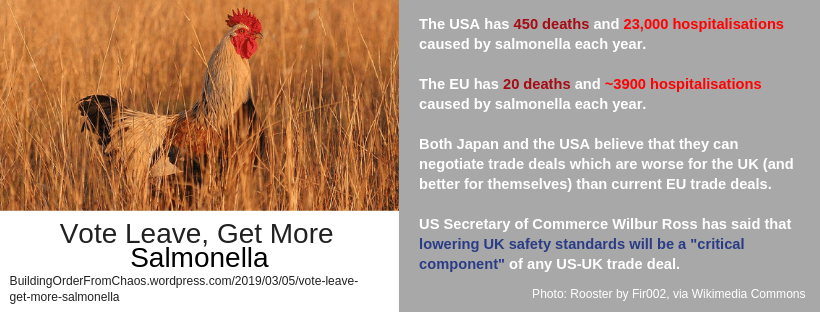
One of the many downsides to Brexit is that it will leave the UK in a weaker position when negotiating trade deals with other countries. According to the Financial Times, Japanese negotiators are demanding more favourable terms from the UK than they agreed to in the recent Japan-EU treaty. American Secretary of Commerce Wilbur Ross has been openly saying for years that accepting lower health standards on food imported from America (such as the infamous ‘chlorinated chicken’) will be a key demand on the American side of a USA-UK trade deal.
Nick Dearden of the campaign group Global Justice Now and Minette Batters of the National Farmers’ Union have warned against lowering UK safety standards. According to Dearden “their animals are raised in such cramped conditions that the only way to stop them becoming diseased is to dunk them in chlorine.”
Using bleach to clean chicken is another method allowed under US regulations but not in the EU. This is in spite of evidence showing that 99% of salmonella cysts survive bleaching, and develop into full-blown salmonella after the testing period.
The American Center for Disease Control “estimates Salmonella causes about 1.2 million illnesses, 23,000 hospitalizations, and 450 deaths in the United States every year.”
According to a report co-authored by the European Centre for Disease Prevention & Control and the European Food Safety Authority, the total number of salmonella cases in 2016 was 94,000 illnesses, ~3800-3900 hospitalisations*, and 20 deaths caused by salmonella.
In pure numbers this means that there are almost 6 times as many salmonella-linked hospitalisations in America, and more than 22 times as many deaths. There are approximately 512 million people living in the EU and 326 million people living in the USA, meaning that the figures per capita are even more dramatic. It works out at almost 71 hospitalisations per million in the USA compared to 7.6 hospitalisations per million in the EU. There are 1.38 salmonella-linked deaths per million in the USA compared to 0.039 deaths per million in the EU. This works out at ratios of more than 9-to-1 per capita and more than 35-to-1 per capita respectively.
Of course there are all sorts of other factors that complicate the picture. The expense of American healthcare will likely discourage sick people from seeking help at an earlier stage than their equivalents in the UK or France. And it’s plausible that the poorer nations of the EU don’t have as strong an infrastructure to monitor and track illness in as much detail as the CDC, so there may be illnesses in those countries caused by salmonella that aren’t represented in official figures. But the gap between levels of salmonella in the USA and EU is worryingly large.
EU regulation is based around the ‘precautionary principle’ – the principle being that “if there is still no scientific consensus on the issue, the policy or action in question should not be pursued.”
American trade representatives argue that EU regulations – such as a ban on hormone injections into cattle – are unscientific. Essentially the difference is that when the evidence is unclear, the EU are cautious about the effect on public health, whereas America is not. We know that America has lower standards for the rearing of animals and that America has higher levels of salmonella, but it might be a coincidence, so regulators won’t intervene.
According to Wilbur Ross, getting rid of “unnecessary regulatory divergences” such as higher safety standards will form a “critical component of any trade discussion”. We’ve been warned.
* I’ve not been able to find a total figure for hospitalisations, but the story at the link indicates that a subgroup accounted for 1766 hospitalisations, or 45.6% of all hospitalisations. This indicates that the total should be around 3873.**
** All subsequent calculations are worked out with the figure rounded up to 3900.
 Happy Sisyphus