
The official name of North Korea is the Democratic People’s Republic of Korea. East Germany’s official name was the German Democratic Republic. Do their names prove that the countries were democratic? The obvious answer is no, that the names alone prove nothing. Delving deeper, both North Korea and East Germany hold and held elections. But those elections were and are elections in which the voter has the option to approve or reject a single candidate, so that could be used as evidence for or against the argument that they are democratic.
But few would argue that these limited forms of democracy are democratic in the sense the word is used in 21st Britain.
Throughout his life Adolf Hitler had a series of rich benefactors. The businesswoman Helene Bechstein provided finance when Hitler was rebuilding his image after imprisonment, and put him in touch with other financial backers, such as Gertrud von Seidlitz and Ernst Hanfstaengl. The financial backing of Fritz Thyssen – who in 1928 ran a company which controlled three quarters of Germany’s ore reserves and employed 200 thousand workers – was infamous enough to prompt the communist satirical magazine AIZ to depict Thyssen as Hitler’s puppeteer.
In a 1933 speech Hitler announced that “the government will not protect the economic interests of the German people by the circuitous method of an economic bureaucracy to be organised by the state, but by the utmost furtherance of private initiative and by the recognition of the rights of property.” He went on to put these promises into action.
Although ‘de-nationalisation’ had been used since the 1920s to refer to the sale of state-owned assets to the private sector, the now common term to describe this process – ‘privatisation’ – appears to have originated in 1930s Germany. Maxine Yaple Sweezy, Hans Wolfgang Singer and Sidney Merlin, writing in 1941, 1942 and 1943 respectively, commented on the sale of state assets to private buyers. According to Sweezy, “in return for business assistance, the Nazis hastened to give evidence of their good will by restoring to private capitalism a number of monopolies held or controlled by the state”. Singer reported that “factories and machine tools which were previously only leased to private businessmen are now to be sold to them.”
When trying to answer the title question, the key term to consider – in my amateur opinion – seems to be ‘Prussian socialism’. According to an essay in a 1939 issue of Virginia Quarterly Review, “in the first years of the German republic the term [socialism] was in the air, and anybody who wanted to sell something to the voters, or merely to get an audience, resorted to it automatically”. One of these academics was Otto Spengler, who, in the Review’s words, propagated “a brand of socialism which was anti-Marxian, anti-republican, anti-proletarian, nationalistic, bellicose, capitalistic, and aristocratic”. According to the Review Spengler’s writing developed the idea that “Marxian socialism and capitalism were merely the two faces of the same coin, the substance of which was thinking in money.” Prussian socialism was the idea that the nation should be organised in a militaristic manner, with every person advancing according to their abilities rather than inheritance or patronage. But Prussian socialism isn’t the Marx-inspired socialism that a 21st century reader will think of when hearing the word. This context is important when thinking about the rebranding of the German Workers’ Party as the National Socialist German Workers’ Party in February 1920.
There are 79 mentions of Marx and its variants in Mein Kampf’s 179 pages, most of them negative. Hitler referred to “the nonsense of Marxism” [page 15]; “the fight against Marxism” [46]; “the lying Marxist papers” [68] and claims that “the only remaining question was whether its founders enjoyed the results of their creation, as seen in its most recent form, or whether they themselves were the victims of an error” [19-20]. He drew attention to Karl Marx’s Jewish ethnicity – definining Marxism as a Jewish invention. This is in spite of Marx being an atheist whose parents converted from Judaism to Protestantism, and his co-wroter Friedrich Engels being completely non-Jewish.
Hitler referenced “the Jewish doctrine of Marxism” [20]; “the Jew, Karl Marx” [59 & 94]; warned against what would happen “if the Jew, with the help of his Marxian creed, conquers the nations of this world”. [20] Hitler claimed that “Marxism is the enunciated form of the Jewish attempt to abolish the importance of personality in all departments of human life, and to set the mass of numbers in its place.” [114]. There are instances of Hitler seeming to use Marxism as a synonym for Jew in famous anti-semitic conspiracy theories. He argued that during the First World War Germany was sabotaged by “the advancing forces of Marxism and pacifism, crippling the body of our nation” [81]; claimed that “a section of German industry did make a determined attempt to avert the danger, but in the end, it fell a victim to the combined attacks of greedy capital, greatly assisted by its truest friend, the Marxist movement” [66] and wrote that Germany “gave in unconditionally to Marxism on November 9th, 1918” [141]. If we are to judge Mein Kampf as a fairly reliable example of Adolf Hitler’s beliefs, he doesn’t seem to be an admirer of Karl Marx or Marxism. Maybe he was more attracted to Spengler’s Prussian socialism, which argued that capitalism and Marxism were expressions of the same movement? Hitler referred to “international Marxist-Jewish stock exchange parties” [88] and wrote that “Marxism possessed an objective and is aware of constructive ambition (even if this is merely erection of a despotism of Jewish world-finance)”. [117]
But we shouldn’t think that Hitler and the Nazi Party took their beliefs entirely from Otto Spengler. In 1933 (the year Hitler took power) Spengler wrote The Hour of Decision, in which he argued that “what is needed is not a pure race, but a strong one, which has a nation within it.” National socialism then, was also different in practice from the Prussian socialism Spengler proposed. It seems fair to assume that Spengler would also have disapproved of the privatisation-driven profiteering of the Nazi state given his dislike of “thinking in money”.
In the decades before Hitler wrote his diatribe, the hoax Protocols of the Elders of Zion (claiming to show the notes of a Jewish plan to control the world) was published by Russian secret police, and republished by Henry Ford’s Dearborn Independent to an readership of hundreds of thousands. Meanwhile there was violent antisemitism in Germany of 1921 notable enough to be reported in the Manchester Guardian. The philosophical roots of National socialism seem to be a version of Prussian socialism infused with antisemitism and free-market capitalism, rather than owing any ideological debt to Marxism.
In recent years the former Tory minister Norman Tebbit; Tory MEP Syed Kamall; Trump pardonee Dinesh D’Souza; American podcasters Stephen Crowder and Ben Shapiro; Tory blogger Ian Dale; Tory MEP Daniel Hannan; and Tory Parliamentary candidate Rachel Frosh are among the people to have spread the idea that Nazism is rooted in socialism. All eight are people with a right-wing, anti-socialist ideology – it doesn’t necessarily mean that they’re wrong, but they do have a personal interest in people associating moderate left-wingers with Nazism. Karl Marx wrote of the “spectre of communism” being used to attack relatively moderate politicians as extreme. The pattern is repeated here, with D’Souza, Tebbit and the rest trying to invoke the spectre of Nazism.
Norman Tebbit’s Tory government are widely credited as the first democratic government to introduce widespread privatisation of state assets, following on from the Chilean dictator Augusto Pinochet. There’s more of a policy-based argument to be made that the Tories are the philosophical inheritors to the Nazi Party than Labour and the left, but you rarely hear that argument made by mainstream left-wingers. Maybe it’s a desire not to mislead, or just basic human decency that makes the difference.
An argument could be made that North Korea and East Germany are and were democratic, just in a more limited sense than we would generally use the word in 21st century western democracies. But if a person is trying to make that argument they should be clear on the fact that they’re using an uncommon definition of the word. Similarly an argument could be made that Nazi Germany was a Prussian socialist state in practice. But that’s different from the superficial argument that a name alone is proof.
***
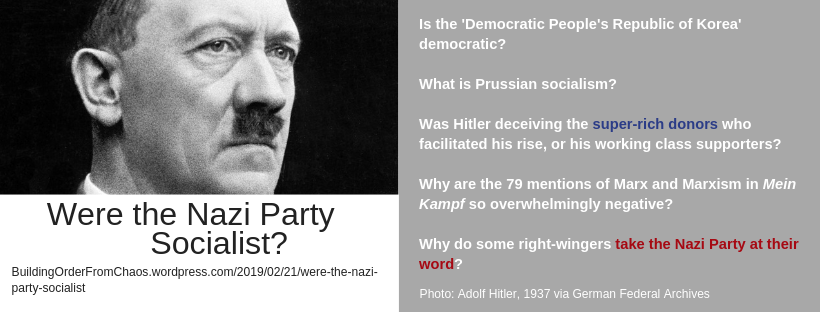
Is the ‘Democratic People’s Republic of Korea’ democratic?
What is Prussian socialism?
Was Hitler deceiving the super-rich donors who facilitated his rise, or his working class supporters?
Why are the 79 mentions of Marx and Marxism in Mein Kampf so overwhelmingly negative?
Why do some right-wingers take the Nazi Party at their word?
 Happy Sisyphus