
As the near-impossibility of putting a practical Brexit into action becomes increasingly clear, public support for a second referendum on EU membership is increasing. A protest in London last month calling for a second referendum (a ‘People’s Vote’) attracted a reported 700,000 participants.
The Brexit campaign was led mainly by former private schoolboys, including the former president of Oxford Union and the founding chief executive of the Somerset Capital Management hedge fund. In spite of this, the campaign has had a populist message about the power of democracy. “Vote leave, take back control” was the official slogan of the official campaign. Although I’m not aware of any leading Brexiteers who have deliberately backed a second referendum, many have made statements over the years which suggest that they would support a second vote in principle.
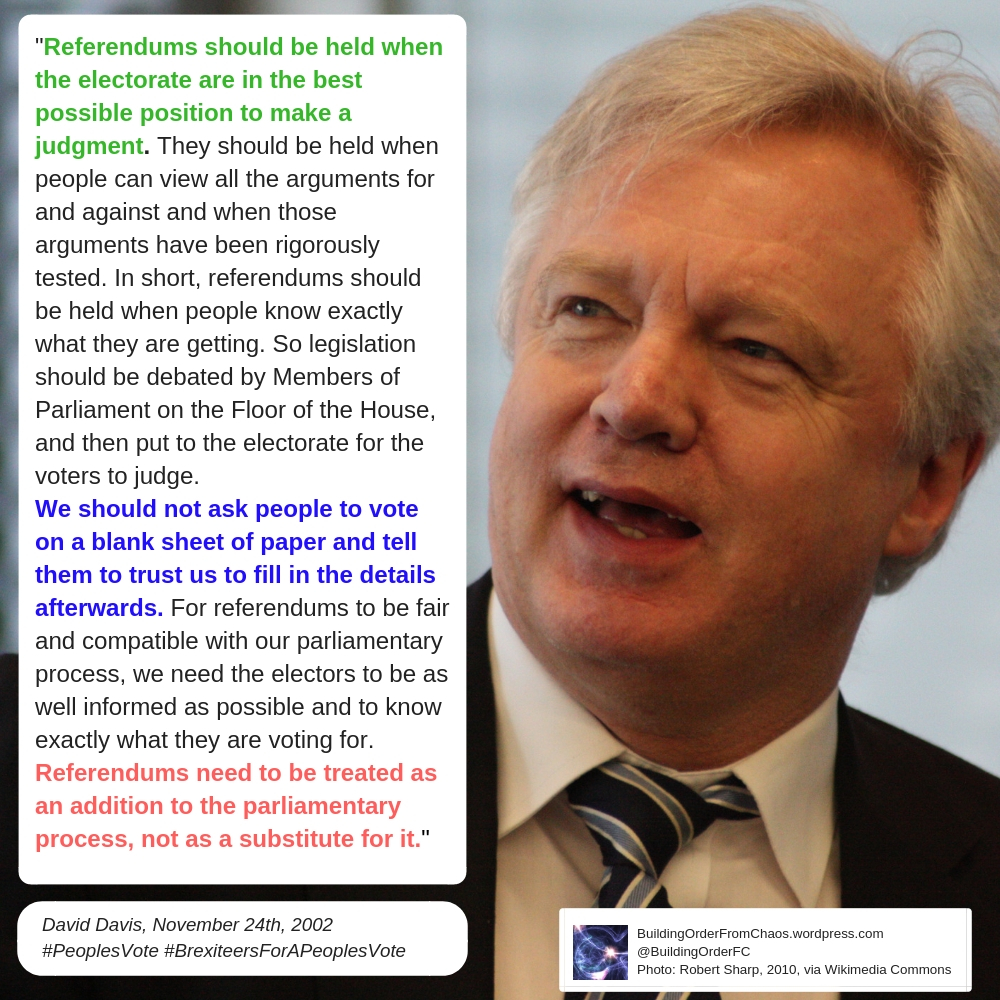
David Davis, 24 November 2002:
“Referendums should be held when the electorate are in the best possible position to make a judgment. They should be held when people can view all the arguments for and against and when those arguments have been rigorously tested. In short, referendums should be held when people know exactly what they are getting. So legislation should be debated by Members of Parliament on the Floor of the House, and then put to the electorate for the voters to judge.
We should not ask people to vote on a blank sheet of paper and tell them to trust us to fill in the details afterwards. For referendums to be fair and compatible with our parliamentary process, we need the electors to be as well informed as possible and to know exactly what they are voting for. Referendums need to be treated as an addition to the parliamentary process, not as a substitute for it.”
Davis was taking part in a debate on a previous referendum, when the British people were asked to consider ‘Regional Assemblies’ within England. (As a layer of government between councils and the national Parliament, they would have had a range of powers similar to the Welsh and Scottish National Assemblies.) Many of the promises sold by the Leave campaigns were vague or contradictory – very close to the “blank sheet” that 2002 Davis warned against. (Hat tip to Jenny Page, who led me to this relatively obscure quote.)
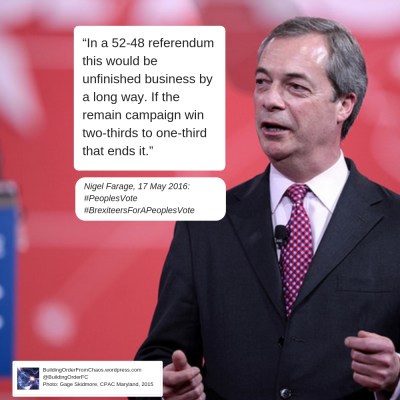
Nigel Farage, 17 May 2016:
“In a 52-48 referendum this would be unfinished business by a long way. If the remain campaign win two-thirds to one-third that ends it.”
This is a more well-known quote. It seems almost impossible, but just 37 days before the referendum Farage really did accidentally predict the referendum result in reverse. I disagree with Farage on a lot, but his point that a 52-48 result would be indicative that more debate and discussion would be needed is one that I agree with.

Jacob Rees-Mogg, 24 October 2011:
“We can, in our wisdom, work out how to phrase a referendum-or series of referendums, if necessary – that will be understandable.
…
Indeed, we could have two referendums. As it happens, it might make more sense to have the second referendum after the renegotiation is completed.”
Speaking in a 2011 debate on a hypothetical future referendum, Rees-Mogg brought up the idea of a “series of referendums”.
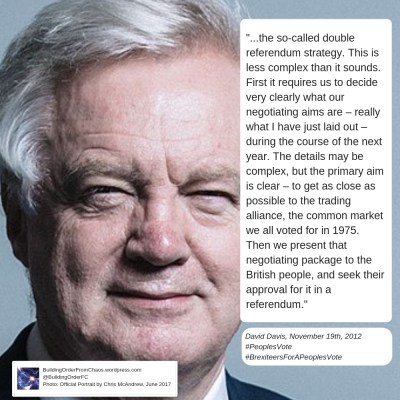
David Davis, 19 November, 2012:
“This leaves us with two issues to resolve. How to negotiate such a change, and how to obtain the approval of the British people for attempting such a historic grand bargain, one which will affect the future not just for them, but for their children and grandchildren.
I believe that we can achieve both of these aims with a single strategy, the so-called double referendum strategy. This is less complex than it sounds.
First it requires us to decide very clearly what our negotiating aims are – really what I have just laid out – during the course of the next year. The details may be complex, but the primary aim is clear – to get as close as possible to the trading alliance, the common market we all voted for in 1975.
Then we present that negotiating package to the British people, and seek their approval for it in a referendum.”
Speaking to Tory Party activists from ConservativeHome.com in 2012, Davis seemed to assume that the majority of the British public shared his preference for a relationship with the EU low on worker regulation, environmental protections and free movement.
Speaking over three years before David Cameron called the (first?) EU referendum, Davis envisioned that the first of his two referendums would set clear terms for negotiation, while the second would give the British people a chance to accept or reject these new terms. In reality the 2016 referendum didn’t set a clear direction of travel. There was a strong implication that extra money would go to the NHS after Brexit, which Boris Johnson, Nigel Farage and Ian Duncan Smith all walked back within four days of the result. Plans for lower standards of food hygiene and less protection for overworked employees weren’t announced until after the referendum.
Davis’ suggestion is a decent one on its own terms, and makes even more sense in the real situation we find ourselves in, given how different the looming reality is from the selection box of potential futures presented to the British people in 2016.
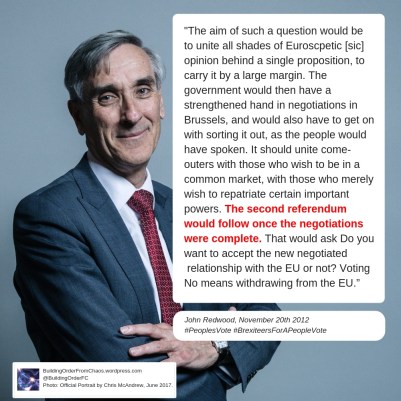
John Redwood, 20 November 2012:
“The idea would be for this government to put through a Bill requiring a Mandate referendum on the EU issue. The question would be: “Do you want the UK government to negotiate a new relationship with the EU based on trade and political co-operation?”
The aim of such a question would be to unite all shades of Euroscpetic [sic] opinion behind a single proposition, to carry it by a large margin. The government would then have a strengthened hand in negotiations in Brussels, and would also have to get on with sorting it out, as the people would have spoken. It should unite come-outers with those who wish to be in a common market, with those who merely wish to repatriate certain important powers. The second referendum would follow once the negotiations were complete. That would ask Do you want to accept the new negotiated relationship with the EU or not? Voting No means withdrawing from the EU.”
Writing on his blog the day after David Davis’ speech, the former Tory leadership contender echoed Davis’ calls for two referendums.
Of course, none of these arguments were intended as calls for a second referendum after their side had won the first. But in each of these cases the Brexiteers are arguing points of principle, and in each case I happen to agree with them. Rees-Mogg, Davis and Redwood all argued for a double-referendum, with negotiations between the UK and EU taking place in-between, giving the British people the opportunity to accept or reject the fruits of those negotiations. If there is to be a ‘People’s Vote’, then their expectations will be met.
Nigel Farage argued that, if the vote on June 23rd were to be narrowly split, then the subject of Britain’s membership in the EU could not be classified as being settled. That makes sense to me. David Davis argued that “referendums should be held when the electorate are in the best possible position to make a judgment”. Again I agree, and I’d say that the vast majority of us know more about Britain’s membership of the EU than we did two and a half years ago.
All five of these arguments are arguments of principle. Arguments of principle should stay the same whether they’re convenient or inconvenient for the speaker.
 Happy Sisyphus