

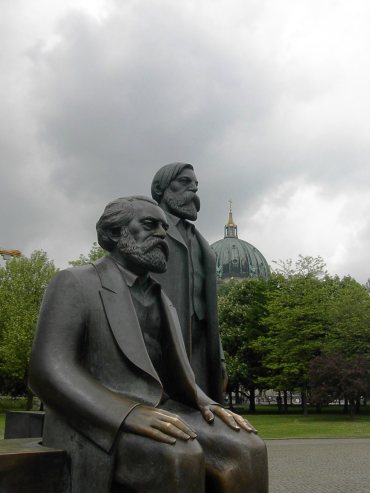
Karl Marx’s central theory was that in modern capitalism there exists two main groups of people (or classes) and there exists a ‘class struggle’ between these groups when their interests overlap. The proletariat are the group who have nothing to sustain themselves but their labours, while the bourgeoisie are the group who own the ‘means of production’ – assets which can be used to create profit. The bourgeoisie have more power than the proletariat, who are reliant on the more powerful group to give opportunities and invest wisely. There is naturally a power imbalance between these groups. Not all of the bourgeoisie will exploit this imbalance, but some will. This, in Marx’s view, explains many of the injustices that occur within a capitalist system.
It’s not necessary to agree with Marx on the proposed solution to think that he was insightful in describing the problems inherent in capitalism. Personally I see communism as unworkable, and support a more regulated form of capitalism. A form of capitalism with members of the proletariat directly elected onto corporate boards in order to stand up for their own interests. Socialism, in other words.
However honorable the bourgeoisie are, there exists a power imbalance. It’s in the self-interest of the bourgeoisie to ignore this imbalance, and pretend that everyone who succeeds in a capitalist system is a ‘self-made man’ who deserves their success. Marx used the term ‘class consciousness’ to describe the act of being able to see through this propaganda. In Marx’s writing, achieving class consciousness is the first step towards building a more just world.
Obviously it’s against the interests of the bourgeoisie for the proletariat to understand the precise way that the deck is rigged against them. As a result, various forms of propaganda spring up to maintain the status quo. Sometimes this originates as a form of self-justification – the bourgeoisie convincing themselves that they deserve their success, or their admirers celebrating them. At other times there is a deliberate attempt to encourage the proletariat to see the world as it isn’t. Marx’s co-writer Friedrich Engels called this ‘false consciousness’.
The idea of the self-made man is one relatively benign example of this – essentially arguing that the poor are responsible for their own poverty. The idea that all political parties are as bad as each other is another form of false consciousness – even if you believe that all are dangerous, obviously some are more dangerous than others.
I’ve seen it argued that left-wing parties want to keep the poor in poverty so that they’re reliant on hand-outs, or that Donald Trump has done more for black employment than Barack Obama did as president. These arguments are false consciousness, in my view, for the simple reason that they’re untrue.
Donald Trump the businessman is a good example of the danger of the power imbalance in the ‘class struggle’. There are dozens of examples of him refusing to pay contractors for work they have completed, and which he had agreed to pay for. The class struggle theory argues that this is the danger in an uneven power relationship, and that we should seek to level out the imbalance.
Another example is IndyMac, a bank later known as One West. Using the legal representation of David J. Stern (described by The Intercept as a “notorious foreclosure mill”) the bank seized the homes of numerous customers under legally dubious circumstances – in many cases the paperwork doesn’t seem to have been properly filled out at the time when the bank seized houses. One of their victims was a Florida man named Cesar Sayoc. Sayoc would later become a supporter of Donald Trump, and this week became one of the most ambitious terrorists in American history – mailing 12 bombs to 10 people. At least 9 of them were allied to Democratic Party and all of them singled out for criticism by Trump in his speeches.
Like any person, the actions of Cesar Sayoc are his own responsibility. But his beliefs were formed in part by the influence of the society around him. He may have been directly hurt by the actions of exploitative members of the bourgeoisie, and yet ended up as a passionate supporter of another exploitative member of that class of people. The main tragedy in what has been a very dark week in America – capped by the 12 deaths in the Tree of Life synagogue on Saturday – is that honorable, decent people can have their lives disrupted and even ended by violent extremists. But a lesser, more pitiful tragedy is ongoing – working class people, exploited by the excesses of the neoliberal capitalist system, but lining up in support of a man with a long history of exploiting people like them.
Why did the ‘MAGA Bomber’ Cesar Sayoc target prominent Democrats?
Sayoc’s home was repossessed by IndyMac, a bank with a history of using incorrect paperwork to take homes from their clients. Was it against his own self-interest to support Donald Trump, a man with a history of non-payment to workers?
In standing behind the type of person who may have exploited him, was Sayoc engaging in what Friedrich Engels called ‘false consciousness’?
 Happy Sisyphus
Leave a comment